Saturday, July 3, 2010

Rudeness, randomness and tactics

First, a brief quiz

You are to find the best line in each of the following positions. In each of them, there may be more than one line that gives an advantage, but you are to find the best one.


Black has just played Bc7xf4. All sorts of things are hanging. What’s White’s best line?


White to move again. Black would be a rook down after Bxf7, but if he hasn’t resigned yet, that’s not going to make him do so. Make him resign.


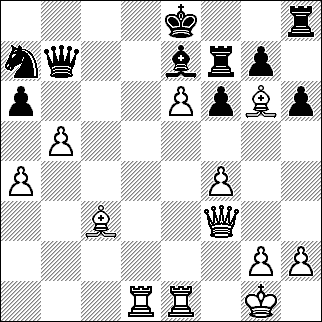
Black to move. This position is more complicated than the first two. :-) White threatens mate with 35.Ra7+ and 36.Qxh8.We have reached this position after the moves 32... Nf3+! 33.Rxf3 Rxg2+! 34.Kh1. Time to finish White off.


White has just played e5. What should Black do?


Rudeness in chess

I had a little talk with Todd recently about rudeness in chess – not verbal rudeness, but situations when one party plays on longer than they should. Perhaps it’s artificial to say that this isn’t verbal rudeness, because in Go (the Japanese board game) this is called “talking with your hands” – that is, your hands are saying is “I think you suck so bad that you can’t beat me even though I’m down a rook.”

But leaving that aside, I’ve started a new study program. I’m actually enjoying it a lot – there are a lot of neat tactics in even the simplest or most one-sided games, and I never really appreciated them back in the day, when I was much more busy beating myself up for not seeing them in the game.

And seeing the tactics is of course the critical factor in whether to resign – are you seeing them; is your opponent seeing them, or does it seem like you can swindle him?

I remember one Continental tournament where John Donaldson was doing that thing where the famous player is manning a room with a demo board and anyone can bring in their games. One of the A-players brought in a game, and Donaldson starting off by praising them for following cutting-edge theory. Then of course one of them deviated and he said “No, you can’t do that” but of course the other player didn’t find the refutation. Donaldson’s cries of “NO!” grew longer and more heartfelt as the game went on, and at one point he dropped his face into his hands, then straightened up and turned to the audience: “I am now officially telling all of you NEVER to resign a game in one of these sections unless you are faced with mate on the move!”

We’ve all been on both sides of this, of course – more often in blitz, but sometimes in slow games. I’ve found a couple of games of my own that are relevant to this theme. But first an answer to our quiz:


The point of showing these positions is to highlight how much aggravation you can save yourself with some tactical precision.

White can win the exchange back by 1.Nxh6+ Bxh6, but then it’s not clear he has a workable advantage at all – the isolated e-pawn may outweigh the two bishops. White can go up a piece with 1.Ne7+ Kh8 2.Nxc8 Bxh7+ 3.Kf1 Ne6 4.Qc2/c3 Bg3 with ideas of Qf4+, Rh1+ and so on. This gets complicated and White is under a lot of pressure. White can make it even more double-edged with 4.Qe7 Bxh2+ 5.Kf1 Qxc8 6.Qxf7 Rh4! but like I said this is complicated.

By the way, White has to take on c8 with the knight if he wants to keep the extra piece: 1.Ne7+ Kh8 2.Qxc8 Qa7+ wins the knight back, as 3.Qc5?? Be3+ is suboptimal.

So especially if White is tired, the best line here is not to bother with the exchange but to cut straight to the chase with 1.Ne7+ Kh8 2.Ng6+! hxg6 3.Qf8+ Kh7 4.Qxg7#. I think that this line is a little harder to spot than usual here, because White might have started out trying to decide what’s the best way to win back the exchange, and once you’ve looked at Ne7+ with the idea of Q/Nxc8, it’s a little harder to then think of it moving in the opposite direction to g6. But it's hard to keep your head and notice lines like this when there's a lot of other stuff going on.

The other quiz positions come from two games of mine, and will be discussed when they arise in the games below:


Shernoff - Richard Lewis Mid-West Amateur Team Championships, 2003 1.e4 c5 2.Nf3 d6 3.d4 cxd4 4.Nxd4 Nf6 5.Nc3 a6 6.f4 e6 7.Qf3 Bd7 8.e5


This is the last quiz position (above).

We were both under the impression that I was winning material here, but this is not the case: 8...Nc6! at least equalizes, because of the hanging Nd4. Suddenly it is White who risks losing material or just getting the worse position. However, Black played a more natural move.
8...Bc6?? 9.Nxc6 Nxc6 10.exf6 Qxf6 11.Bd3 Qd8

Apparently Black was afraid of 11...Be7 12.Ne4

12.0-0 Be7 13.Bd2 Qd7 14.Ne4

I'm preparing to use my pawns to restrain and then chip away at his compensating pawn center

14...h6 15.c4 0-0-0 16.Bc3 f6 17.b4 Na7 18.a4 Rdf8 19.b5 Kd8 20.Rad1 Ke8 21.Nc5 Qc8 22.Bg6+ Rf7 23.Nxb7

Here, I was expecting 23...Qxc4, giving us one of the positions from our quiz:


During the game I was planning 24.Na5 Qc7 25.Qa8+ Nc8 26.Rc1; however, this is inaccurate.

In Go, there’s a concept that gets translated as “inducing move.” You want to make a move for reasons of your own, so you play an otherwise meaningless move that sets the enemy in motion in that direction. Then you play the move you wanted originally, which now has its original purpose plus it stuffs the new motion of the enemy.


Here, White can win a pawn with 24.Rxd6, since 24...Bxd6 is met by a recapture that forks the queen. But 24.Rxd6 itself carries no threat, so Black can just castle and White has only won a pawn. (Well, he can’t castle in the game, but he can if it’s just a quiz position!)

However, after 24.b6! Nc6 25.Rxd6! white captures with tempo, because he’s attacking the knight. Then 25...Nb8 26.Rd8+ forces the knight fork on d6. If Black replies to 24.b6! with 24...Nc8, then 25.Rd4 and (in any order) Rb4 when the queen goes to b3, Be4 when the queen goes to d5, and Ra1 when the queen goes to a2 will trap it.

Back to the actual game:

23... Qb8


24.Rfe1

Fritz wants 24.f5 e5 25.Qd5 Rhf8 26.c5, thus showing that a chess program can be sadistic, but equally good by this point is 26.Nxd6+ Bxd6 27.Qe6+ with mate on d7. However, I didn’t want to just threaten to put a pawn at e6, I wanted to force the pawn there.

24...d5 25.cxd5! Qxb7 26.dxe6

At the post-mortem, my opponent, who was about 10 and very polite and respectful, asked whether at what point it might have been rude of him to continue playing. I suggested that once variations like the one here: 26...Qxf3 27.exf7+ Kf8 28.Rd8+ Bxd8 29.Re8# start appearing, one should either allow them or resign. On the other hand, the position is not exactly annoying for White to play, so the rudeness is minor...

And it also shows that black is not the only one who can be obnoxious by playing on here: after White does the big sacrificial windup for his Morphy-style mate: 26...Qxf3 27.exf7+ Kf8 28.Rd8+ Bxd8


He doesn’t have to actually deliver it: after 29.gxf3 Be7 30.Bb4 Nc8 31.b6 followed by 32.b7 and now White is the one who’s being a jackass by continuing to play. Well, back to the game:

26...Qc7 27.Rd7

Here again Fritz saw a quicker mate with 27.exf7+ Kf8 28.Rxe7! but the one that’s coming will be good enough.

27...Qb8 28.Qd5 axb5 29.exf7+ Kf8 30.Rd8+ 1-0

What surprised me when I pulled the game was how much substantive tactics were in it even though from a competitive standpoint the game is completely trivial. However, in a less crushing position my planned inaccuracy at move 24 might have been enough to let Black back into the game. Likewise the 8...Nc6 shot is well worth spotting, before I give someone else that chance (or someone gives me the opportunity). And then there were the cute politeness “twin” variations at move 26.

The next game, however, is meatier.

Shernoff (2110) - Matthew Bluestone (2160) Ft. Wayne, 1996

This was the most unfortunately memorable tournament location in my experience. Bill Goichberg was experimenting with trying to run Continental tournaments in new locations, and a bunch of us from the University of Chicago chess team tried to help him out by driving down to Fort Wayne. The hotel had a strange landscape in back of it – almost an acre of flat blacktop expanse, with an incredible array of fast-food restaurants sprouting out of it like mushrooms. There were no street or lane markings (or even parking spaces) – just pristine blacktop and fast food.

I went downstairs the first morning and asked the manager if there was someplace cheap nearby that we could eat breakfast. Obviously the blacktop expanse was available but I try to avoid that kind of stuff. The manager said that there was just the hotel restaurant. I said yeah, but these are undergraduates, so I’d like to find someplace cheaper. He said, “There isn’t any.” I said “Not in the whole city of Fort Wayne?” “That’s right.” We ended up at a subway about half a block from the hotel.

The hotel also featured a maid who loudly demanded that we pay her to clean our room, because it was so messy. I just exchanged a stack of towels with her. I considered complaining about this, but then reflected that this would be to the manager who had just insisted that there was no other place to eat in the entire city.
And during the tournament, a very nice sweater disappeared from my hotel room. I am not surprised that Bill did not return to this venue.

My opponent in this game, Mathew Bluestone, was a top college player who was on the Harvard team. Yes, this was back when

a) being rated 2160 made you a top college player, not an above-average high school player
b) such a rating could get you a chess scholarship
c) the only schools recruiting chess players were Ivies
d) you only got a (full or partial) scholarship, not a free ride, a stipend, and a bogus “assistantship” lecturing B-players on the alternatives on move 20 of the English attack in the Najdorf variation
e) you were expected to actually take your classes.

Truly simpler, more innocent days. Our game, however, was neither simple nor innocent.

1.e4 c5 2.Nf3 e6 3.d4 cxd4 4.Nxd4 Nf6 5.Nc3 d6 6.g3 a6 7.Bg2 Nbd7 8.0–0 Qc7 9.Be3 Rb8 10.a4 b6 11.Qe2 Bb7 12.Rae1 Be7

13.Nd5?

Contrary to my earlier experience, this is not always a good move. Here, White should just play f4 and look for play with f5 or g4-g5, now that Black’s king can’t castle queenside. 13.f4 Nc6 can be met simply with 14.Bc1, and now White is threatening 15.b4 Ncd7 16.Bb2, improving the position of his pieces and gaining space.

13...exd5 14.Nf5 dxe4 15.Nxg7+ Kd8 16.Nf5 Ne5


I don’t know about you, but I think that Black has a fantastic position!

17.Bf4?!

I made a long analysis after the game to show that this move is much stronger if my Re1 is on the d-file instead (duh!), but the Re1 actually does a good job of inhibiting ...Nf3+, which I think (in retrospect) Black must have been trying to arrange. Bf4 is still pretty clueless – the bishop should go to g5 right away. And I disagree with both of Black’s pushes of his h-pawn that follow – he should have played a rook to the g-file instead.

17...Qd7 18.Nxe7 Qxe7 19.Bg5 h6?! 20.Bh4 Kc7 21.Qd2 Rbe8 22.Qd4 Qe6 23.Re3

23...Nfd7

Better is Ng6. But now my Bh4 isn’t doing much, so I relocate it to g3.

This game is sort of a weird twin of the first one. Here I’m the one who lost a piece in the opening for no particular reason; however, as in the previous game, Black has met the situation by walking his king around and shuffling his other pieces (maybe he was hoping that I would make another ridiculous sac?) and the tempi he’s wasted enable me to mount a genuine attack. Already (compared to the previous diagram, it’s looking more like I really intended for all this to happen, and in the next diagram it’ll look even better for White (even though by then, ironically, Black has a forced win).

24.g4 Nxg4 25.Rb3 Bd5?! 26.c4 Bc6 27.Bg3 h5?! 28.a5 Rb8 29.axb6+ Kb7 30.Bxd6 Rbg8 31.Ra1 Nge5

So by now the position really does look like White is attacking (my bishop certainly looks a lot better on d6 than it would on h4), but in the meantime I’ve finally chased a black rook to the g-file. So both of Black’s dearest wishes will come true in the next move-pair: I will make another wild sac, and Black will get to play Nf3+.

32.Rxa6 Nf3+

On 32...Kxa6 I was planning 33.Ra3+ Kb7 34.Ra7+ Kc8 35.Rc7+ Kd8 36.Bxe5, which may not be sufficient, but is more than I had any right to hope for after my foolish 13th move. One entertaining continuation is 36...e3 37.Bf6+ Qxf6 38.Rxd7+ Ke8 39.Qxf6 Rxg2+ 40.Kf1 Rxf2+ 41.Qxf2 exf2 42.Rc7 Bd7 43.b7 Ke7 44.c5 and White should do well by pushing those queenside pawns.

33.Rxf3

If the game hadn’t been so eventful already, I might have been tempted to let the queen go here with 33.Kh1. This works out well (and humorously) if Black decides to just go straight for the mate with 33...Qh3.

Things look dire for white, as 34.Bxh3 Rg1# and 34.Bxf3 Qf1# are sub-optimal, and the Bg2 can’t be defended. However, after 34.Ra7+ Kc8 35.b7+ Bxb7 36.Ra8+ Bxa8 37.Rb8+ Nxb8 the queen can now be taken with check: 38.Bxh3+! Nd7 39.Qc5+ with a quick mate. Note the power of the two bishops! ;-)

But unfortunately if Black just takes the queen, White’s ball of pieces on the queenside loses all cohesion and he has no effective follow-up, for example: 33.Kh1 Nxd4 34.Ra7+ Kc8 35.b7+ Bxb7 36.Rbxb7 Qxd6. Luckily I avoided all this temptation, as I hadn’t seen the check at all, and was so grateful to notice my rook covering that square that I just snapped it off!


33...Rxg2+?!

Far be it from me to criticize a flashy move that could have led to a forced checkmate, but it is simpler to just recapture: 33...exf3 34.Ra7+ Kc8 35.Rc7+ Kd8 36.Bg3 fxg2 37.Bh4+ f6 38.Bxf6+ Ke8 when White's checks come to an end and Qe1# is threatened.

34.Kh1?

Strangely, this is a mistake.

Giving us our third quiz position.

I can’t capture the rook: after 34.Kxg2? exf3+ 35.Kf1 Qe2+ mates on the back rank, and 35.Kg3 Rg8+ is too gruesome to contemplate. But the king should have gone to f1 instead. Supposedly, Michael Stean once said “If you have only one move that doesn’t lose instantly, there’s no excuse for not finding it!” The trick is to know when you only have one move.

Black proceeded optimally for a while:

34...Rhg8 35.Ra7+ Kc8 36.Rc7+ Kd8 37.Rg3

But now he missed 37...Qh3!!, forcing checkmate. This is why the king should have gone to f1 instead of h1. Then Black would have been legitimately over-extended. But this Qh3 shot is one of those moves that’s not terribly difficult to find when you’re given a quiz position and told that Black has a forced mate. In the game, after all the confusion that has come before, it’s hard to keep a clear head and notice the possibility.

37...R2xg3? 38.fxg3 Qh3 39.Qd1?!


Better was the self-defence with 39.Kg1, after which my Fritz of the time put White up almost three pawns, which is pretty amazing considering the actual material situation.

39...Ba8?

More in the spirit of the game (true, by now Black was probably pretty sick of the spirit of the game) would be 39...Ba4!, with the idea of 40.Qe1 Nxb6, although after 41.Rxf7 the mate on f1 is covered and White’s queen is free to roam again. But it once again becomes a difficult game.

There is a clear win here for White, but (as with 37...Qh3!!) it requires extraordinary tactical precision and a clear head, which pretty much guarantees that we wouldn’t have found it in the game.

First White has to realize he can save the b-pawn with (39...Ba4!) 40.b7! and the threat of 41.Rc8# doesn’t give Black time to take the queen. Then Black plays 40...Nb8!


and now after 41.Qe1 Bc6 Black has disturbing counterplay. So White has to win the bishop with 41.Rc8+ Kd7 42.Qxa4+

And now we’re at the third crossroads. There’s mate hanging on f1, and White’s instinct to always go forward when attacking the king may get him into trouble. He may even forget about Black’s knight and hang his queen after something like 42...Ke6 43.Re8+ Kf5 44.Qd7+?? (skewering the black queen!) or 43...Kxd6 44.Qa6+??

Here White has to see that moving the queen back to where it was before is good: simply 42...Ke6 43.Qd1 or 42...Kxd6 43.Qd1+ Ke7 44.Rxg8 are dead won for White.


Even Fritz showed more sense here, suggesting 39...h4!, with the idea of 40.Rxc6 hxg3 41.Qe2 and the position is still complicated.

By the way, it does look like we were in a wee bit of time pressure here coming up to move 40, and our tactikular precision suffered a mite because of it. But actually the first time control was at move 30, and Matt’s brain was just melting from all the crap we’d been through. But now I shut him down smoothly after

39...Ba8? 40.b7 Bxb7 41.Rxb7 Rg6 42.Bf4 Ke8 43.Rb5 h4 44.Rh5 Qe6 45.Qd5 hxg3


46.hxg3!?

It hardly matters that I missed a quick mate here with 46.Qa8+ Ke7 47.Bc7. A Tal or Shabalov may have been happy and proud to go for a continuation like 47...g2+ 48.Kg1 Qxc4 49.Qd8+ Ke6 50.Qe8+ Kf6 51.Be5+, but I was playing on a “no further craziness allowed” imperative. I realize that this sort of contradicts one of the themes of the post – that one should try to be super-precise and finish off the opponent quickly so as to avoid screwing up later. But, tired from all that has come before, there’s actually a lot more chance of me screwing up a line like this than in playing a simple endgame where I have a clear advantage.

Though I have to add that I pretty much saw the continuation up to the next diagram at this point, where it’s a lot simpler position, and this tips the balance. If queens were going to stay on with my king so open, then it would have been better to look for the quick mate.

46...Qxd5 47.Rxd5 Rb6 48.c5 Rxb2 49.c6 Nb6 50.c7 Rc2 51.Rd8+ Ke7 52.Rb8 e3

53.Bxe3!? Rxc7 54.Rxb6

In objective chess terms, 53.Rxb6 e2 54.Rb1 was better, but I just didn't want to bother thinking any more. And that line does leave open the option of me trying to approach the pawn with 55.Kg2?? d1/Q+. :-)

Note that I did NOT say that this line would have “speeded up the game.” Given my opponent’s behavior from here on, that might have been true in terms of number of moves, but not in terms of hours out of my life. This brings us back to the rudeness theme.

Bluestone had used up all of the first time control a long time ago, and (in playing the game out) sat very deliberately and used all his time for the sudden death control also, making the game last well past the starting time for the next round. In fact, he offered me a draw later on when I repeated moves (I said “No thank you.”).

I suppose he wasn’t just trying to be obnoxious, because my score sheet shows that I repeated moves a little bit further on (I needed a lot of calming down after that middlegame, and was proceeding along the lines of “do not hurry”) and he didn’t offer a draw again. He can’t have been hoping I would make another random sacrifice because, sadly, he doesn’t have anything left that I can sac for. But he didn’t resign until after (note the move number)


No question about White making progress!

80.Kg6 Rc6+ 81.Bf6 Rc8 82.Rh7 1-0

with about thirty people watching in a circle around us, including the TD tapping his pen on a scorepad.


Here’s one last thought about people who get upset with you because they’re insulted that you played “garbage” (or “not real chess”) against them: the result doesn’t matter. If you lose, they will be insufferably self-righteous and lecture you on the proper understanding of the game, and if you win they will be furious because you must have cheapoed them somewhere and destroyed the logic and beauty of them winning to show you how stupid you are.

I’ve been on both sides of that one, too.

Saturday, May 15, 2010

Darga-Spassky, part 2 (the most beautiful bishop ending in the world)

This continues the game Darga-Spassky, Round 1 of the Amsterdam Interzonal, 1964. The first 92 moves of the game (!) are in a separate post, Darga-Spassky, part 1. This post attempts to solve the resulting bishop ending at move 92, given best play.

This ending (or at least my posting of it) has a story behind it. When I was playing through these interzonal games, I stopped and wondered why Spassky didn’t play 92...Bc2 instead of his obviously silly blunder. At first, I couldn’t find a way for White to win if Black just kept shuffling his bishop between c2 and d1. I spent some time looking at it and found a win that I thought was really beautiful. I was very enthused.

Okay, time passed. I hadn’t played or looked at chess for a while. I had a pair of chess friends visiting from out of town and I thought it would be cool to pull out this ending. To my horror, I found that I hadn’t written down the winning method. I spent some time that afternoon trying to reconstruct it, but to no avail. Well, no biggie, I thought: my friends are both strong players so we’ll just figure it out together over dinner. To my surprise, we were unable to do so. The bishops danced and danced, but zugzwang was elusive and no other winning method presented itself. A couple of weeks later, I closeted myself with the ending for the weekend and eventually figured it out. So here it is. I hope you enjoy it.


If Black plays the best defence,

92...Bc2

Then the critical position arises after the forced exchange of d-pawn for g-pawn:

93.Bd5 Kd7

If Black tries to hold the g-pawn, he immediately gets into zugzwang: 93...Bd1? 94.Bf7 Bh5 95.Ka4 Kd7 96.Kb5 Kxd6 97.Kb6 Ke7 98.Bg8 Kd6 99.Bh7. I’m pretty sure that this was the line that so impressed me with its beauty back when; now it seems a bit callow.

94.Bf7 Kxd6

Black should just take the d-pawn and leave his bishop on c2. As in the game, if he tries to attach the bishop to the c-pawn, he just loses more quickly: 94...Bd3 95.Kb3 Kxd6 96.Bxg6 Ke7 97.Bh5! Bf1 98.Bf3 Bd3 99.Bd5 and Ka4-a5

95.Bxg6


White has "two weaknesses" to play with. One is the f-pawn, and the other is the possibility of king penetration with Ka4 (which I suppose boils down to the weakness of the c-pawn).
White's aim is to produce a position where he is attacking the f-pawn while only Black's bishop is defending it; then Kb2 will force the bishop to choose between abandoning the f-pawn or allowing Kb3-a4, so here for instance 95...Ke7? 96.Kb2 Bd3 97.Kb3 +- as above.

95...Ke6! 96.Bh5!

In a simpler world, White would be able to play 96.Bh7, which forces Black's king to move away from the f-pawn and allows White to complete his strategy. Unfortunately, after 96...Kf7 97.Kb2 Bd3 98.Kb3 Kg7 the bishop runs into a bit of trouble, and the position becomes equal. 96.Bh5 also restricts Black’s bishop.

96...Ke7 97.Bf3


so white has to attack the f-pawn from the other side, where he has a longer diagonal. If you put the white bishop on c8 here, you see that White has an immediate win on the next move with Kb2. To prevent this, Black would have to commit all his resources immediately: 97...Kd7 98.Bb7 Bd1 (to meet 99.Bc8+ Kxc8 100.g6 with 100...Bh5 101.g7 Bf7) but this loses to 99.Ba6 and now Black can’t move his bishop, or move his king away from c8; so we get 99...Kd8 100.Bb5 Ke7 101.Ba4 B moves, 102.Bc2 and Ka4.


So Black’s best defence is to bring the K around to the other side of the pawn:

97...Kf7 98.Bb7 Kg6! 99.Bc8 Bd1 100.Bd7 Bc2 101.Be8+ Kg7

and here White has three tries:


A) 102.Bh5 Kh7 and White makes no progress

B) 102.Ka2 Bd1 103.Kb2 Bf3 (or Kh7) 104.Bd7 Kg6 and again White must reset the diagram position with 105.Ka3 Bd1 106.Be8+

and the winning line:

102.Ba4! Be4
103.Bd7 Bc2
104.Kb2

Bingo. Mednis would be proud.

Depending on how many steps Black's king took to reach g7, this position can also be reached with Black's bishop on d1. Then white wins as in the 97...Kd7 variation after 102.Ba4 B moves 103.Bc2 and Ka4.

So what do you think? Is it beautiful? Nice? Just another bishop ending? Is it worth falling on your sword to avoid all of this? Spassky had a slow start to the tournament, and not just because he lost this: his other early-round games didn't go so well, either. Maybe it had something to do with spending all his rest days sitting with Darga pushing the bishops around for another few hours.

Here's how the actual game went, from the starting point of this post:


92...Be2?
93.Ka4 Bxc4
94.Ka5 Be2
95.Bb5 c4
96.Ba4

Just a little fancy. The more natural line would be 96.Kb4 c3 97.Ba4

1-0

I wonder how long it would take a strong computer to find the win after 92...Bc2. They don’t have the concepts of “White wins if the king passes a4” or “the bishop needs to come around to the longer diagonal” so its search would be tremendously less efficient, and it might originally reject the whole concept of Bxg6/...Kxd6 as exchanging a pair of pawns while Black’s king comes out of the box. Though of course after a few billion bishop and king shuffles I’m sure it would converge on a solution.

Darga-Spassky, part 1

This game is the intersection of a couple of interests for me. First of all, I’ve found that when top-notch players lose, the game is usually something special. In this case that is very true, although sometimes it’s “special” as in “cool” and sometimes “special” as in Special Olympics. The other interest at the time was self-improvement: I had decided to play through all the games of an interzonal, to see how some top-notch players played against each other and against people who weren’t quite so good.

Darga - Spassky Amsterdam IZ, 1964

1.Nf3 Nf6 2.c4 e6 3.g3 b6
Spassky playing the QID? It soon becomes clear that this is not a good choice.
4.Bg2 Bb7 5.0-0 Be7 6.Nc3 0-0 7.d4 Bb4?!
Losing a tempo in order to give up the two bishops when your position is already really passive is not a good idea.
8.Qb3 Bxc3 9.Qxc3 d6 10.b3 Nbd7 11.Bb2 Re8 12.Rad1 Rc8 13.Rfe1?! Qe7 14.d5 e5 15.Nh4


Black's position is looking more and more like one of those textbook passive/inferior positions that will soon be wrecked by some attractive sacrifices. Put white’s rook back on f1 and use that tempo to play f4 and it becomes even clearer.

15...Nc5 16.f4 Nfd7 17.e3 a5 18.Qc2?!

Darga doesn't lose his advantage this way, but he shouldn't be pretending Black's queenside "play" amounts to anything. He has a huge space advantage and the two bishops, and he should be concentrating on a way to kill Spassky's king.

18...f6 19.a3 Ra8 20.Bc3 Qf7 21.Rf1


21...exf4 22.exf4?

I think this is where Darga starts to go really wrong. As played the rooks will just get exchanged on the e-file, instead of White being able to place them behind a pawn-storm. The crowd wants 22.Rxf4 when Black can't take the e-pawn because of 22...Rxe3 23.Nf5 Ree8 24.Rg4, threatening both Rxg7 and Nh6+

22...a4?!

The knight is just out of play on b3

23.b4 Nb3 24.Nf5 Nf8


25.Nd4?

Just leave the Nb3 alone! White should play something like 25.Kh1 and Rg1, Be4, g4-g5. To me, this is just the quintessential Soviet game. Throughout it, Darga seems to have the philosophy of just playing solidly, doing nothing the least bit interesting, and letting Spassky hang himself. Well, it eventually works, but the whole process would have been less painful for everyone if he’d just played real chess for more than one brief phase of the game.

25...Nxd4 26.Bxd4 Qg6

Another reason to have kept a knight on f5. I'm sure that Edmar Mednis would be thrilled beyond words to exchange queens with the two bishops in hand, but 99% of all other chess players would have wanted White's huge space plus to amount to something more substantial.

27.Qxg6 hxg6 28.Rfe1 Kf7 29.Kf2 Ba6 30.Bf1 f5?!

Now Black's king is tied down to the weakness at g7, and his bishop is worse.

31.Rxe8 Rxe8 32.Re1 Rd8 33.Bd3 Nd7 34.b5 Bb7 35.Bc2 Nc5 36.h4 Nb3

The same mistake twice!

37.Bc3 Bc8 38.Re3 Bd7 39.Re1 Rg8 40.Re3

It's hard to tell whether white is in time trouble and just wants to make the time control before doing anything, or is just dicking around to make the point that he can. Judging by his play later in the game, it's the latter.

40...Nc5 41.Bd4 Ra8 42.Ke1


42...Ne4 43.Bd1

Spassky is willing to give up a pawn immediately just to get opposite colored bishops, and indeed 43.Bxe4 fxe4 44.Rxe4 Re8 45.Rxe8 Bxe8 46.Kd2 Bd7 47.Kc3 Bg4 48.Kb4 Be2 is a clear draw

43...Re8 44.Bxa4

Darga, for his part, is willing to trade a good pawn for a lousy one in order to get the rooks off

44...Nxg3 45.Rxe8 Bxe8 46.Bc2 Nh5 47.Be3 Ke7


48.a4

Now Darga plays very energetically, precisely and resolutely for the only time in the entire game, and acquires a winning advantage. Edmar Mednis would faint for joy over his play over the next 17 moves.

48...Kd7 49.a5 bxa5 50.Kd2 Ng3 51.Kc3 g5! 52.hxg5 Bh5 53.Kb3 Be2 54.Bd2 a4+ 55.Kb4 a3 56.Bb3 Ne4 57.Be3 g6 58.Kxa3 Nc5 59.Bxc5! dxc5 60.Ka4 Bd3 61.Ka5

White will spend the rest of the game trying to achieve this sort of breakthrough again.

61...Be2 62.b6! cxb6+ 63.Kxb6 Kd6 64.Kb7 Bd3 65.Kc8 Be2


White now has a fairly standard win by walking his king over to f6, forcing Bh5. Then Black has to move his king, and (after Ba4-b5) White will be able to play Ke5, d5-d6, Kd5 and take the c-pawn (or just queen the d-pawn if Black puts his king on b6).

I'm wrong here -- as Todd Rowland points out in his comment below, Black has a stalemate cheapo: 66.Kd8? Bxc4! 67.Bxc4 stalemate. So Black has an unusual sort of "blockade" along the back rank, and the position must be drawn because the White king has no route into the Black position.

66.Kb7?? And all these question marks are undeserved... :-)

However, Darga, under some sort of hallucination, now painstakingly negates all his previous progress. This is the sort of continuation that gives rise to those stories of Soviet collaboration...

66...Bd3 67.Ka6?? Bf1 68.Ka5?? Bd3 69.Ka4?? Bf1 70.Ka3?? Be2 71.Kb2?? Ke7 72.Kc3 Kd6 73.Bc2 Ke7 74.Bd3 Yeah, that's going to work 74...Bd1 75.Kd2 Bb3 76.Be2 Kd6 77.Kc3 Ba4 78.Bd3 Bd1

At this point, both players seem to feel that all black needs to draw is to keep his bishop on this diagonal to keep the White king out -- counterattacking the c4 pawn if necessary.

79.Kd2 Bb3 80.Kc1 Ke7 81.Kb2 Bd1 82.Bc2 Be2 83.Kc3 Kd6 84.Ba4 Ke7 85.Bb5


85...Kd8 ?!? ?? And this is just a losing move.

At first, I thought that this gives White some chances he doesn't deserve, after Black has clearly demonstrated that he knows how to draw. But perhaps White can just place his bishop on b3 and walk his king up the board anyway, decoying the Black king if necessary by pushing the d-pawn.

This shows a big difference between chess then and modern chess with sudden death time controls. Both players (being much stronger than me and seeing the stalemate defence) must have realized that the position was a dead draw, for the reasons mentioned above. However, Darga was able to exercise his privilege of playing on and on and on, and eventually Spassky either lost concentration, had a mad impulse, or committed a fingerfehler... we'll never know. In a modern situation, Black could have pointed out that White isn't really trying to make progress and had the game called a draw that way -- and White wouldn't have been able to continue without risk, since he would also been in danger of losing on time.

Perhaps one day we'll consider the adjournment era as backwards as the pre-clock 1800s, where the slower players used to consider for hours over one move.

86.d6!?

This rules out the win just mentioned, because of the vulnerability of White's d-pawn. So now the win is very complicated. On the other hand, if the win in the last note doesn’t work, then this is White's only winning try and Black blew it on the previous move.

86.d6 Bf3 87.Kb3 Bd1+ 88.Ka3 Bc2 89.Bc6 Bd1 90.Ba4 Be2 91.Bb5 Bd1 92.Bc6


At this point, Spassky played 92...Be2? and resigned four moves later. However, he can continue his previous policy of king-containment with 92...Bc2, reaching the critical position for this ending. That position is the starting point for the second post in this series, Darga-Spassky, part 2 (the most beautiful bishop ending in the world)

Friday, November 20, 2009

Sometimes tournament chess is like getting hit upside the head with a huge fish

Those people who don’t play our royal game often imagine chess to be this detached, cerebral exercise. (Cue fiendish laughter here) For the last couple months, I’ve been getting settled in at my new job with Wolfram Research which has been great but has also left me with very few spare brain cells for appreciating chess. Which has meant that – through absolutely no fault of my own – in the few spare moments when I’ve tried to get this blog going again, my taste in games has gravitated towards games that are the Caissic analog of a roadrunner cartoon.

Case in point:
Victor Chubakov-Leon Shernoff Maroon Kings Tournament, University of Chicago, 2002

1. d4 d5 2. c4 c6 3. Nf3 Nf6 4. Nc3 dxc4 5. e4


The Geller Gambit (or Tolush-Geller Gambit), a sharp continuation that is considered unsound at the GM level, but not below. On the one hand, I’ve seen games where the young Kasparov lost as White; on the other hand, I was present at a tournament where perpetual “could be IM if I felt like it” David Gliksman used it (as white) to crush Igor Ivanov, who then immediately used it himself (even though of course it’s completely not in Ivanov’s style) to crush another IM in the last round. (Gliksman, if I remember correctly, drew with Michael Brooks in about 7 moves to share first place between them)

I used to play a gimmicky continuation invented by Smyslov, but gave it up because of bad results, even though I always got good positions. Also because I realized it was just unsound in one game (confirmed by John Donaldson in the post mortem), even though my opponent didn’t see it in the game.

5... b5 6. e5 Nd5 7. a4 e6

The main line. The other major continuation is 7...h6. Also possible is 7...Qa5 (according to my book, anyway) and 7...Be6 (Smyslov's continuation), with the idea of Nxc3, Bd5, and e6.

8. axb5 Nxc3 9. bxc3 cxb5 10. Ng5 Bb7 11. Qh5 Qd7

Okay, this is also a legitimate way to reach the main line (11...g6), but also a gimmicky sideline in its own right. White can't take 12.Nxh7 because after 12...Nc6 Black threatens sacrifices on d4. You’ll get the idea of what happens then from what happens here.

12. Be2 Bxg2 ??

Based on the results of this game, I have to say that this move is just losing, even though it had been played at the GM level before (and possibly since).

Black should just play 12...g6 to enter the main line. He then plays Be7 and goes for the setup with Bd5 and Nc6. I, however, had memories of Black grabbing this pawn thus keeping White's king in the center (see Kievelitz-Crouch, Decin 1996 at the end of this post), so I got over-ambitious.

Though, to be honest, I had another problem with the main line, in that book (at this point in time) had White able to force a repetition with stuff like 12...g6 13.Qh4 Be7 14.Qh6 Bf8 (if Black can’t castle, he’s doomed) 14.Qh4 Be7 (see previous comment) 15.Qh6, etc. I don’t know whether this assessment has changed in the meantime. But it seems like an attractive line for a lower-rated player, as Black either has to allow this draw or play one of these cheesy sidelines that subject him to a ferocious attack.

13. Rg1


13...Bb7!?

Afterwards, I thought that better would be 13...Bd5, as in Kievelitz-Crouch. However, I was still hoping to get my Nxd4 sac in, so I left the d-file open. And in fact, Couch should have been vulnerable to the exact sort of continuation that I was here, but he wouldn’t have had the open d-file for counterplay (such as it is).

14. Nxh7 Nc6 15. Nf6+ gxf6 16. Qxh8 Nxd4!?


Quiz question #1: What is White’s best response to this move? Hint: there is a very, very, very clear answer. To help you avoid peeking, I will babble on for a little while to fill up the page.

My thought at the time was that objectively Black's just losing here, so he has to start the complications right away. 16...0-0-0 just hands Victor the correct line: 17.Rg8, and now if Black starts the same sort of fun with 17...Nxd4 18.cd Qxd4, White is always a capture ahead of him after, say, 19.Rxf8 Qxa1 20.Rxd8+ Kc7 21.Rd1

After the game, I said to Victor that this was similar to last year's game, in that after a certain point we entered a tactical flurry, and I prevailed in the period of mutual oversights. The interesting thing about this year's game is that neither of us realized how early that period began.

Okay, if you’re still looking for a hint, I’ll tell you that the most important feature of Black’s last move is that it gives up control of the b4 square, which means that black can’t push his b-pawn if he needs to.


Here, Victor can win with 17.Qxf8! Kxf8 18.Ba3+, giving Black the lovely choice between 18...Ke8 19.Rg8# and 18...Qe7 19.Bxe7+ Kxe7 20.cxd4, capturing the knight under, ummm, superior conditions.

Is the roadrunner theme becoming clear to you yet?

So objectively, Black should have castled last move, even though it sucks. I think you’ll agree with me that the pawn grab Bxg2 was bad, in that Black’s two moves ...Bxg2 and ...B retreats are worth a lot less than White’s corresponding moves Rg1 and Rg8. So better, actually, to castle on move 12 instead of grabbing the g-pawn. But then White‘s king wouldn‘t be trapped in the center and Black would have little play. Best not to enter this line at all.

Victor was also (unbeknownst to me) starting to hallucinate, in that he rejected 17.Rg8 because of 17...Nc2+ 18.Kf1 Nxa1 19.Rxf8+ Ke7


because he "didn't see a mate" and didn't want to be "only up a piece" after taking twice on a8. After the game, we agreed that just being up the piece was good, but there are also at least three quick mates in the position! See if you can find them! The answer is at the end of the post, as “Mate cluster #2”.

I, of course, was going to castle on move 17, entering the "correct line" that I didn't want him to find (above).

The game continued:


17. cxd4?? Qxd4 18. Rb1?

Again, there's another long mate after the thematic 18.Rg8 Qxa1 19.Rxf8+ Ke7


and 20.Rxf7+. I’ll let you find it on your own, and I’ll put the answer at the end of the post. It’s not easy to visualize all the way to the end. Objectively, it looks like the passive move in the game blows White's advantage. Which means that if it takes so many ?? moves for White to not be winning then ...Bxg2 probably deserves something like four or five question marks instead of two.

18... O-O-O


19. Rg8??

At this point, White has to come back and defend against Qc3+ with Qh3 or Rg3. Fritz’s reasoning for declaring the position almost equal then seems to have been something like 19.Qh3 Qxe5, but I tend to distrust grabbing pawns as compensation for a whole rook. Ramming the c-(and b-?)pawn(s) down the board looks more appropriate to me. Another line is 19.Kf1 Bf3! (threat Qd1+; 19...Bc5? 20.Qxf6 defends f2) 20.Bxf3 Bc5! with threats against f2 and h8.


19... Bb4+??
Black wins after 19...Bg2!! The threat of Qc3+ compels 20.Rg3 or Rxg2, and Black then wins White's queen with 20...Bb4+
20. Rxb4??
It is especially embarrassing to admit that I was planning on 20.Kf1 Qd1+ 21.Bxd1 Rxd1+ and Re1#, not noticing that this is illegal because my rook is pinned on the back rank (by two major pieces!). But at least this is a mate. I'd been playing for it in some other lines where the Re1 is supported by a Nc2 instead of the bishop (after 17.Rb1, for example). There, it isn't even mate, as the king can go to d2!
20... Qc3+
Victor had overlooked that his Bc1 would be hanging here.
0-1


Here are a few of the games I had studied, with light notes.
(this is well-documented getting hit upside the head with a fish)

Kievelitz-Crouch, Decin 1996
1. Nf3 d5 2. d4 Nf6 3. c4 c6 4. Nc3 dxc4 5. e4 b5 6. e5 Nd5 7. a4 e6 8. axb5 Nxc3 9. bxc3 cxb5 10. Ng5 Bb7 11. Qh5 Qd7 12. Be2 Bxg2 13. Rg1 Bd5 14. Nxh7 Nc6 15. Nf6+ gxf6 16. Qxh8 O-O-O 17. Qxf6? (Rg8, of course, but White is still winning.) 17...b4 18. Bb2 a5 19. Bh5 a4 20. Rxa4?
(20. Qxf7 Qxf7 21.Bxf7 a3 22.Bc1 and Black's would-be pawn roller is already pre-undermined.)
20... Nxd4 21. Rxb4?!
(21. Ra2 Nc2+ 22.Kf1 (22.Ke2?? Bg2) 23.Bc6 and Black will have to play for an attack)
21... Bxb4 22. cxb4 Be4! 23. Qxf7 (23.Rg7 Nf5 0-1) Nc2+ 24. Kf1 Qd3+ (25...Qh3+ is also good) 0-1


Jiretorn-Chmielinska, European Women’s Ch, Warsaw 2001
This game shows what happens if White takes the exchange without playing 12.Be2 first.

1. d4 d5 2. c4 c6 3. Nf3 Nf6 4. Nc3 dxc4 5. e4 b5 6. e5 Nd5 7. a4 e6 8. axb5 Nxc3 9. bxc3 cxb5 10. Ng5 Bb7 11. Qh5 Qd7 12. Nxh7 Nc6 13. Nf6+ gxf6 14. Qxh8 O-O-O 15. Qxf6 Nxd4 16. f3 Nc2+ 17. Kf2 Bc5+ 18. Kg3 Rg8+ 19. Kh3 Nxa1 20. Be2 Nc2 21. Rd1 Bd5 22. g4 (and as you might imagine, Black won handily) Ne3 0-1


O'Cinneide-Hurley, Bunratty (Ireland) Open, 2000
And this game shows what happens if White tries to get fancy in the corner.

1. Nf3 d5 2. c4 c6 3. d4 Nf6 4. Nc3 dxc4 5. e4 b5 6. e5 Nd5 7. a4 e6 8. axb5 Nxc3 9. bxc3 cxb5 10. Ng5 Bb7 11. Qh5 Qd7 12. Nxh7 Nc6 13. Nxf8 Qxd4 (!!) 14. cxd4 Rxh5 15. Be3 a5 16. Be2 Rh4 17. Nxe6 fxe6 18. O-O-O Nb4 19. Bg5 Rh8 20. Bd2 Nd5 21. Kb2 Rf8 22. f3 Nf4 23. Bf1 Bd5 24. Rc1 Kd7 25. Rc2 Kc6 26. Rg1 Kb6 27. g3 Ng6 28. f4 Rac8 29. Be2 b4 30. Rgc1 Kb5 31. h4 Rc6 32. h5 Ne7 33. g4 Rfc8 34. Be1 Kb6 35. Bh4 c3+ 36. Kb1 R8c7 37. Bxe7 Rxe7 38. Bd3 Rec7 39. f5 b3 40. Rf2 a4 41. f6 gxf6 42. exf6 a3 43. h6 a2+ 44. Ka1 0-1

Moral of the story: all the sidelines in the 11...Qd7 line are good for Black; it’s only the main line that’s are completely lost!

Mate cluster #2

Mate 1) 20. Rxf7+ with Bh5+ and Qxf6#
Mate 2) 20. Qxf6+ with Qh8+ & Bg5+, with similar play; and
Mate 3) 20.Ba3+ which I consider emotionally equivalent to mate, even if it doesn't lead to a quick mate on the board


Here’s that longer mate at move 18:
18.Rg8 Qxa1 19.Rxf8+ Ke7


20.Rxf7+ 21.Bh5+ Now it's a mate in 8: 21...Ke7 22.Qxf6+ Kd7 23.Qf7+ Kd8 24.Qf8+ Kd7 25.Qd6+ Kc8 26.Qxe6+ Kc7/d8 27.Qd6+ Kc8 28.Bg4#

I have to say that after going over this game with a computer, I felt like it was a totally wretched game. However, after trying to find this particular mate myself, I have to admit it’s tough (or at least stressful) to do with (from the diagram position) mate hanging on c1 and the rook hanging on f8.
Likewise, a move before, it’s easy for the computer to see that 16...Nxd4 should be answered with 17.Qxf8, but it’s hard to notice that you should steel yourself and “ignore” the “loud” move Nxd4 and just play a sacrifice of your own. Another mental block in that position is it can be difficult to realize that you’re just winning so early in the game. On the other hand, Victor’s comments afterwards showed that he did realize he was winning, so

I suppose I can’t fault either of us much for missing the computer tactics on move 19; however, it was sheer luck that his ?? oversight outranked mine on move 20. Certainly not the most embarrassing game I’ve ever played, but it makes me think that perhaps one of the reasons chess is superior to roadrunner cartoons is that in chess both sides can get multiple anvils dropped on their head in the very same game.

Comments? I've added a poll.

Monday, September 7, 2009

Elizabeth and Lars have corrupted me

Okay, I tried to keep this all chess, all the time, but (a) Elizabeth has been blogging about all sorts of random things for a while now and why should she have all the fun? and (b) my soon-to-be former workmate Lars has shown me one of the few golden opportunities I've ever seen to use the power of the internet to further the cause of world civilization.

So here it is: which of the following re-dubbings of the same rant from the movie Downfall are the funniest?

Hitler Learns that the Vikings Have Signed Brett Favre
Sample line: "Everyone who wears a Helga hat to bed, please leave. You must not hear what I have to say." (3/4 of the Nazis leave the room)

Hitler Learns That Michael Jackson Has Died and so Will Not Be Performing at his Birthday Party
Sample line: "And the worst part is, I never even got a chance to go to Neverland."

Hitler Finds Out He Has Been Banned from XBox Live
Sample line: "I had over 2000 Microsoft points!! I bought a Call of Duty theme pack, too!"


Note that I stayed away from less skillful ones, like "Hitler Learns there is no Santa Claus" or political ones like "Hitler Learns that Sarah Palin Resigned", but you can find them easily through the YouTube related links. And for the connoisseur, I understand that there is also a version of this up where Hitler is ranting about all the different versions of this that are up...

Wednesday, July 22, 2009

Two – no, three – Utterly Ridiculous Games

Well, I was so bored the other day that I succumbed to the madness of reading Geurt Gijssen’s arbiter column on ChessCafe, and – as unfortunately so often happens with bad behavior – I was richly rewarded with the most ridiculous game I’ve ever seen, which someone had submitted for an official opinion.

I won’t have time to make anything like a real chess post for a week at least, so I thought I’d throw this out there – especially for any of you whose brain may have been fried by the 8 x 8 queens post.

The question was whether, in a game where White starts with his king and queen in each other’s positions, is the checkmate after
1.e4 e5
2.Bc4 d6
3.Kh5 g6#


legal? Or – more to the point – does the result stand in a tournament game?

The questioner quoted a whole bunch of rules relating to making an illegal move, which I didn’t read because I don’t really give a damn. Gijssen said that the more relevant rules were those governing pieces being set up wrong in the starting position – if it’s discovered during the game, the game must be restarted from the beginning (with, one hopes, the pieces set up correctly).

However, he added, since giving checkmate and pressing one’s clock ends the game, then the result of the game must stand, even though it would really pain him to allow it. He proposed several technical rule changes to allow such a game to be disqualified, which (of course) I didn’t read either, since if I’d been that bored I would have been banging my forehead against the computer, not reading stuff on it.

My main point in sharing is that this is just a hilariously ridiculous game, and it’s even more hilariously ridiculous to see an international arbiter approaching it seriously. I mean, this is a game where White (a) attempts the Scholar’s Mate while (b) not noticing that he’s moving his king to h5. What are the chances that this is going to occur in an event governed by the laws of FIDE?

Furthermore, I think that Gijssen is just dead wrong for two reasons:
First of all, what the hell are the standards for “discovering” that the pieces were set up wrong – or that an illegal move was made earlier in the game? It’s hard to imagine that Black delivered checkmate without “discovering” that it was his opponent’s king he was checkmating. I mean, unless he played 4...g6 and then went “Wait a minute! That’s your king!”

For Gijssen’s logic to be correct, both players have to have realized that the piece on h5 was a king immediately after (and only after) Black played 4...g6. After all, if White still thought it was a queen, he would have just retreated it to f3 and the game would have continued. To constitute “discovering” that the pieces were set up wrong, is Black somehow required to blurt out “Oh my God! That’s your king on h5! It must have come from d1, where it was set up incorrectly in the initial position and it was an illegal move to bring it out to h5!”? Give me a break. If Black delivered checkmate intentionally, it’s hard to imagine that he didn’t also realize that the king’s appearance on h5 was not quite kosher.

An alternative, of course, is that perhaps the helpful arbiter who submitted the question pointed out that a checkmate had occurred, when neither player had noticed it. (In this case, the arbiter should simply be shot, because he should have let the kids play) I have no idea what the rules are on continuing the game after checkmate, because (like I said) I’m not that bored. I’m just a bit intrigued by the ridiculousness of it all.

Okay: the second reason that Gijssen is dead wrong is that White should be forfeited on principle for attempting to mate on f7. Quite honestly, this should overrule all other considerations. Especially with children. Granted, perhaps this is a Nakamura game (blitz playoff?) where he decided to revert to his Qh5 repertoire, but in that case he should lose even more so, because it might influence young people.

I once had an eight year old student who would not accept that this strategy could possibly be bad. I lectured him sternly about the need to get all your pieces out, but he would not listen. “Okay,” I said, “we’re going to play a practice game.” This went:
Howard – Leon
CalArts, ~1990
1.e4 e6
2.Bc4 Nc6
You see, I have prepared for my opponent’s repertoire.
3.Qf3 Nd4
and here he joyfully picked up his queen to deliver checkmate at f7, only to discover that his bishop was blocked. And that he had a problem on c2. Consternation ensued.

(Here, actually, you see why this mindless checkmate goal is such a destructive meme: here’s a kid who – when he looks freshly at a position – can notice that not only his queen is attacked but there’s also a costly fork on c2. And yet, when planning his mate, he was so deeply on automatic that he didn’t notice that my e6 pawn blocks his bishop from f7)

The game continued:
4.Qc3 Bc5 I considered 4...c5, but thought it wouldn’t teach him as much about the importance of development if I won while behind in development. Luckily, the game finished very “instructively”:
5.d3?? Bb4
6.Qxb4 Nxc2+
0-1
because of 7...Nxb4 coming

A much nicer game, which actually accomplished its instructional purpose and got me the best parental response that I’ve ever had or heard of. Howard was a bit sulky after the game, so I thought it best to give his mom a little heads-up on what had happened.
So I drew her aside when she came to pick him up and said (quietly, out of the side of my mouth, like a secret agent) “We played a training game today, and I, uh, sort of kicked his ass.”
Mom: Well, I should hope so! We are paying you after all!

She also reported the following week that in his games with his father, Howard had taken to admonishing him over and over to get all his pieces out. It is good to have one’s instructions taken to heart.

If my math is right, Howard is almost 30 years old now. I wonder if he still plays chess.

The Third Ridiculous Game
When I started this post, I called the first game the most ridiculous one I’ve ever seen, but then I realized that wasn’t true. The most ridiculous chess game I know of goes
1.e4 e5
2.Qh5 Ke7
3.Qxe5#

But that’s just so offensively ridiculous that I won’t even give it a diagram. It does seem to show, though, that there’s a theme of an early Qh5 being associated with ridiculousness. Elizabeth Viccary just made a post where she mentions an argument among some players about what move is most often a good one (or bad one) – wherever it occurs in whatever game. I’d make a case for Qh5 to most often turn out to be a silly move.

Sunday, July 5, 2009

8 x 8 Queens

The famous Eight Queens problem has always fascinated me, perhaps because I’m so bad at it. The problem is to place eight queens on the chessboard in such a way that none of them attack one another (diagram shamelessly copied from Wikipedia).

I actually think that the reason it’s so fascinating to me is because I can’t see any pattern for the placement of the queens. I mean, a lot of the queens are a knight’s move apart, which only makes sense, since it’s the closest way to pack them without them attacking one another. But obviously this also gets broken quite a bit, and there turns out to be no simple heuristic as to where to start over once you’ve run your string of knight-related queens to the edge of the board (as happens on the left-hand side of the diagram).

This would also be why I’m so bad at it – because I can’t see any overall pattern. So ideally, to “subdue” this problem, I’d want to find a way to see patterns in it – by which I mean human-recognizable ones, not paper algorithms that can generate a solution but can’t be perceived over the board.

Another thing I’ve wondered about off and on is how many eight-queen solutions can be placed on a single board, where one is not allowed to put more than one queen on a square. In other words, can I put one set of eight yellow queens on the board such that none of them attack one another, then put a set of blue queens on vacant squares such that none of them attack one another, and so on for eight sets of eight queens?

Packing: the Rotational Approach
Now, these patterns are much too random-looking for me to just try mixing and matching them. One needs a heuristic. The first one involved packing a whole 8-queen pattern into one quarter of the board via rotation.

For instance, if I give the board three quarter-turns, and on each turn I “trap” whatever queen is in the lower-right, then I’ve packed all eight queens into one quarter of the board. If I can do this without any of them landing on top of one another, I’ll have proved that the initial position can be rotated four times to give us four solutions that fit on the same board. The diagram below shows how our initial position fails this test:

Here I’ve colored the home square of each queen, and colored the square that it packs to (in the lower right) the same color. Six of the queens rotate without interference, but the two on the magenta squares map onto one another, ruining the situation.

Well, let’s not try to break down an existing pattern – let’s try to generate one of our own. And let’s not bother with the four rotations, let’s immediately test for eight.

Generating our own solutions
This quarter of the board can be split in half down the long diagonal. If I can take each eighth of the board and spin it out into a valid eight-queens pattern, then the way I’ve generated it will prove that (a) it can be spun three times to give us four non-interfering eight-queens patterns, and (b) it can then be flipped across the long diagonal to give us four more – our ideal solution of eight non-interfering patterns.

It’s not quite as simple as that, because the long diagonal squares can’t each be divided in half. But one can split them two and two: for instance in the diagram above, one can take the set of the six yellow squares plus the two deep blue ones on the long diagonal, and then take the set of the six light blue squares plus the two black ones on the long diagonal. If both sets can be spun out into a valid eight-queens pattern, it will show that it is possible to fit eight sets of eight queens on a chess board.

It is fairly easy to show that this is impossible. Let’s start with the central dark blue square and work our way down the column of yellow squares beneath it:

Already, ominously, there is only one rotational slot possible for the second square (possible rotations shown in green). And there is only one for the third square (shown in magenta). By the time we get to the fourth square, there is no space available for it that doesn’t attack an already placed queen.

The reason for this is easy to see: we’re starting out with four squares on the same column, and there are only four rotations available. Therefore, we have to distribute our rotations with optimum efficiency, one queen each on the two central columns and two each on the two central rows. But queen number one is already on both a central column and a central row, taking up two slots. Thus, we can only add two more queens before running out of slots. The exact same problem applies with the corner square.

I believe that there are similar issues with light-blue-centered eighth of the board, but those would be more complicated to demonstrate. In the meantime, it’s clear – there can be no fully 8x8 queen solution generated in this way.

Is this a packing problem or a tiling problem?
Well, this got me thinking about approaching the problem in a related way: these rotational rings of queens don’t attack one another; so if I can find a pair of rings that cover the whole board without attacking one another (a) it’ll be pretty cool and (b) it might open the way to seeing other patterns.

Well, that doesn’t work. In fact, if we make a ring of queens that are on rotations of the square e3:

We find that just two more queens (in the lower left and right corners) completely cover the board. Now we’re starting to get more human-grokkable patterns, but we’re also straying a bit from the task. So I started to wonder: is this a packing problem or a tiling problem?

It’s sort of a mixture of each: if it’s a packing problem, then it’s to find the most efficient packing given a constraint (queens can’t attack each other) that makes the packing very inefficient; or, if it’s a tiling problem then it’s to find the least efficient tiling given a constraint that tends to make the tilings maximally efficient. This is an issue especially with our 8 x 8 queens task, since it's actually a packing of a packing (or a packing of a tiling?).

Okay, so let’s take a look at whether this ring of queens idea can give us patterns that need less than six queens to control (or occupy) the whole board. One does not have far to look for a generalized solution!

For each non-mutually-attacking rotational ring of queens outside the central sixteen squares, the four queens in the ring leave exactly four squares uncovered. These squares are symmetrically distributed on the long diagonals, so that one more queen on any of these four squares covers them all and completely controls the board.

In other words, now that we’ve shown that e3 needs six queens to cover the whole board, the five remaining yellow squares from our original eighth-board formation all have five-queen solutions to the problem of covering the whole board. Here are those formations:

e2 (I’ve just colored the appropriate squares rather than drawing actual queens)


f2


e1


f1


g1


A few points here:

1) I think this exhausts the solutions possible with five queens. I don’t have a proof, but these five patterns strongly exploit both the rotational symmetry of the board and that of the queen herself. As soon as I mess up the symmetry, the solutions start requiring more queens.

2) I will hold out the possibility that there may be a solution with four queens, randomly and brilliantly placed (sort of like the famous problem of how to connect nine dots with only four straight lines). But I think the probability of this is low.

3) Among these five solutions, each uses a different long diagonal square except that two use the corner. However, you can see that I have cunningly notated one corner in the lower left and one in the upper left (all other long diagonal squares are in their lower left rotation). This means that (a) we can place each of these five solutions on the chessboard at the same time without any queens landing on top of one another, and (b) we can then flip this composite solution horizontally to give us a total of ten solutions packed onto the same chessboard.

I like this.

Update: after writing all this, I did some online research and found out that there already exists a proof that five queens is the minimum number to completely cover an 8x8 chessboard, and that moreover there are 638 “basic” solutions that can be rotated and reflected to produce a total of 4860 distinct positions satisfying the condition. But intriguingly, the position given as an example follows the same form as my five solutions: a ring of four queens plus one “cleaning up” on the long diagonal. I wonder how many of the solutions follow this form.

Back to the original problem
Can this shed any light on our original problem of the eight queens, and how many of them can be packed onto a chessboard? It does. Let’s take a look at Wikipedia’s solution #1 again:

Although the presence of queens at d8 and h5 mean that this solution can’t be rotated a quarter-turn in either direction, it can be rotated 180 degrees. That gives us the following pair of solutions, notated here with red squares for the original queens, and blue squares for the rotation:

Now I call that an amazingly regular pattern – one that is very human-understandable! First of all, this is a pair of solutions packed onto the same board. But one can also easily see by looking at the pattern that it can be flipped either horizontally or vertically without any of the queens landing on top of one another. But then it can’t be flipped again, because either of these flips gives us the same composite pattern of four solutions packed onto the same board. (This is actually a result of the operations we’ve done, since flipping horizontally followed by flipping vertically is the same as rotating 180 degrees)

Looking at the existing “basic” eight queens solutions (there are only twelve), there aren’t any whose composite patterns of four magically compliment one another, giving us the ideal eight solutions. However, there is at least one pair of eight-queen patterns where the solution and one reflection can fit into the space left by the full composite of another.

Each of the twelve basic solutions must also be a distinct eight-queen pattern in either of its reflections, since for a reflection to have a queen land on top of another means that those queens must have started out on the same row or column – an impossibility giving the starting restrictions. Each of the twelve basic solutions also possesses exactly one non-interfering rotational version. All twelve patterns contain at least one pair of queens that interfere with one another rotationally, but those that contain two pairs interfere with each other at the same number of rotations.

So each basic eight-queen pattern can be packed onto the board with exactly three other versions of itself. And once this is accomplished, there is at least one pair of basic patterns where two permutations of the second pattern can be packed onto the board with the full four permutations of the first.

Let’s take a look. Here is Wikipedia’s pattern #2:


In passing: I like the way this pattern contains two permutations of my e3 tiling covering the chessboard with six queens:

Okay, here is Wikipedia’s #2 pattern rotated 180 degrees and then flipped horizontally (or vertically):

So far, so good.
All right, here is Wikipedia’s pattern #12:

You can see that it fits in the blank spaces left in the diagram just above it. Let’s flip this one horizontally:


This one fits, too, so let’s put them all together:

This gives us six eight-queen patterns packed onto a single chessboard.


Okay, summing up:

1) I think that this is a maximum packing for eight queens. Just looking at the twelve basic solutions, they all interfere with themselves or one another if you try to do more than six on a board. This is still a very concrete result, though, achieved by spot-checking the twelve basic solutions for rotational interference. I have no idea how to give the result (generalized or specific) in theoretical terms – for starters because I have no idea if there exists any way to represent the basic solutions themselves in theoretical terms.

2) I find it interesting that the five-queen solution can be packed onto a chessboard ten times, and the eight-queen solution six times – as close to being inverses of one another as the number of queens being used allows. One occupies 50 total squares on the chessboard and the other 48. I wonder how this number will behave for other numbers of queens on other sizes of chessboard. I imagine that as the board gets larger, it will become possible to fill a larger and larger proportion of the available squares with queens – by an analogy with knot theory, where as you increase the number of dimensions, it becomes easier and easier to slip out of a knot, and also because as the board increases in size the queen becomes proportionally less powerful.